
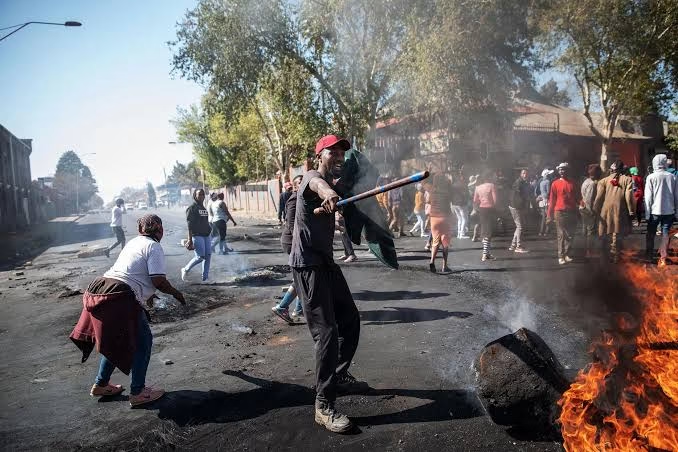

The manicured gardens, gleaming homes and bustling restaurants that define South Africa’s affluent suburbs are beginning to feel the consequences of the country’s latest wave of xenophobic violence.
Across Johannesburg, Cape Town and Durban, domestic workers, gardeners, security guards, nannies, farm labourers and hospitality staff—many of them migrants from Zimbabwe, Malawi, Mozambique, Ethiopia and other African countries—are staying away from work, fleeing the country or going into hiding after weeks of attacks and intimidation targeting foreign nationals.
The labour shortages expose an uncomfortable reality about South Africa’s economy: while migrants have increasingly been blamed for taking jobs, many businesses and wealthy households have quietly become dependent on them.
More than 25,000 migrants have fled South Africa in recent weeks following nationwide anti-immigration protests that left at least four people dead and triggered fresh attacks on foreign-owned businesses. Others have stopped reporting to work after receiving threats or witnessing assaults in their communities.
For employers in affluent neighbourhoods, the impact is becoming increasingly visible.
Restaurant owners say experienced kitchen staff have disappeared overnight. Landscaping companies are struggling to complete contracts. Domestic employment agencies report cancellations as foreign workers fear commuting. Fruit and wine farmers, particularly in the Western Cape, warn that harvesting schedules could be disrupted if the exodus continues.
“What many South Africans are only now discovering is that migrants occupy critical positions throughout the economy,” said one labour market analyst. “Removing thousands of workers almost overnight creates shortages that cannot immediately be filled.”
The shortages have reopened an uncomfortable debate over the country’s dependence on migrant labour.
For decades, South Africa’s wealthier households have relied on migrant workers willing to accept jobs that many unemployed South Africans either do not seek, lack the necessary experience for, or view as poorly paid. In agriculture, construction, hospitality and domestic work, foreign nationals have become an integral part of the labour force.
Research has repeatedly challenged the argument that migrants are responsible for South Africa’s unemployment crisis.
Foreign-born residents account for roughly 4% of South Africa’s population, while studies suggest migrants are more likely to create businesses than displace local workers. Crime statistics have similarly failed to support claims that foreigners are responsible for disproportionately high levels of crime. Economists instead point to weak economic growth, poor governance and structural unemployment as the primary causes of the country’s jobs crisis.
Yet those findings have done little to slow anti-immigrant sentiment.
Groups leading recent demonstrations have accused undocumented migrants of taking jobs and overburdening public services, arguments that have gained traction as South Africa grapples with one of the world’s highest unemployment rates and prepares for local elections later this year.
The economic costs are now extending beyond labour shortages.
Justice Minister Mmamoloko Kubayi has warned that xenophobic violence is damaging South Africa’s international reputation and triggering retaliation against South African businesses operating elsewhere on the continent. Several African governments have begun repatriating their citizens, while South African artists have reportedly seen performances cancelled in neighbouring countries amid growing public anger.
Agriculture appears particularly vulnerable.
Farmers have warned that uncertainty surrounding migrant workers could disrupt planting and harvesting seasons, threatening production in sectors already battling rising costs and climate pressures. Many farms depend on experienced seasonal workers from neighbouring countries whose specialised knowledge is difficult to replace at short notice.
Business groups are increasingly concerned that prolonged labour disruptions could spread into logistics, food processing and retail supply chains if more foreign workers decide not to return.
President Cyril Ramaphosa has condemned vigilante attacks and insisted that immigration enforcement should remain the responsibility of the state rather than citizen groups. His government has simultaneously promised tougher immigration controls while warning against violence and scapegoating.
The contradiction confronting South Africa is becoming harder to ignore.
The same migrants accused of taking jobs have long been quietly sustaining businesses, harvesting crops, maintaining affluent homes and staffing restaurants that underpin daily life in the country’s wealthiest communities.
As thousands leave, South Africa is beginning to discover that removing workers is far easier than replacing them.