

Kenya’s politically influential Odinga family has moved its 35% stake in fuel marketer Be Energy to an offshore vehicle registered in the British Virgin Islands, adding a fresh layer of opacity to a company already at the centre of Kenya’s high-stakes fuel supply chain.
Regulatory filings show the shares were transferred from the family’s investment arm, Pan African Petroleum Limited, to Africanable Corporation, a BVI-registered entity. It remains unclear whether the move represents an outright sale or an internal asset restructuring.
The British Virgin Islands, widely regarded as a zero-tax jurisdiction, is a preferred destination for global capital seeking confidentiality, with corporate ownership structures often shielded from public scrutiny.
Boardroom changes signal continuity
Even as ownership shifts offshore, the Odinga family’s influence inside Be Energy appears intact.
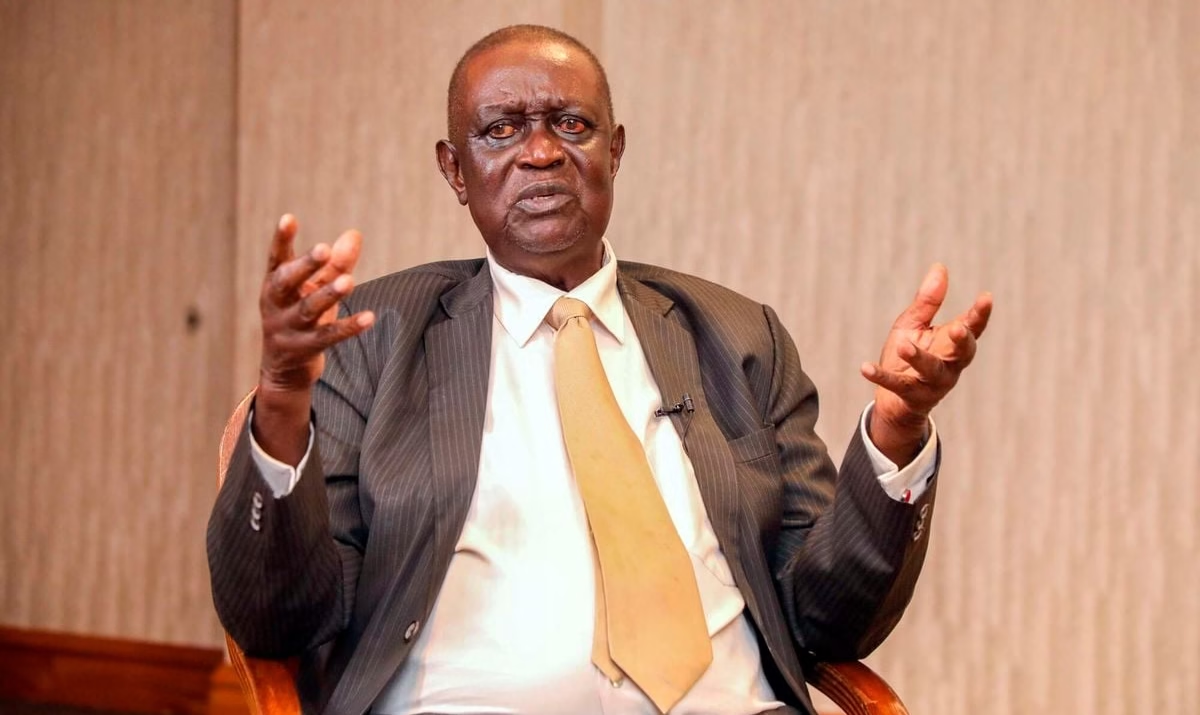
Filings indicate that Siaya Senator Oburu Oginga and Raila Odinga Jr. have exited the board, only to be replaced by individuals closely aligned to the family. Among the new directors is lawyer Jackson Awele, a long-time associate of the late former Prime Minister Raila Odinga, alongside William Ojonyo, a cousin to both Raila and Oburu.
The changes suggest a recalibration rather than a withdrawal, preserving strategic control while altering the company’s formal ownership structure.
Fuel deals, politics
The ownership shift comes as Be Energy consolidates its position within Kenya’s lucrative government-to-government (G-to-G) fuel import framework.
Since March 2023, Kenya has sourced petroleum products through long-term supply agreements with Saudi Aramco, Abu Dhabi National Oil Company, and Emirates National Oil Company, replacing the previous open tender system.
Under this arrangement, select local oil marketers purchase fuel on extended credit terms and distribute it domestically. Be Energy is among a small group of firms—including One Petroleum and Orxy Energies—granted access to the rotational import allocations.
The company’s inclusion followed a political rapprochement between President William Ruto and Raila Odinga, formalised in 2025 after a surprise détente the previous year. That alignment has since fuelled debate over the intersection of political power and commercial opportunity in Kenya’s energy sector.
Critics have pointed to the risk of crony capitalism, where proximity to state power can shape access to lucrative deals.
A growing player
Be Energy’s rise has been steady. Its market share grew from 2.4% in 2020 to 3.17% by late 2023, driven by sales of nearly 100 million litres of petroleum products over six months.
It is now ranked among Kenya’s top oil marketers, trailing multinationals such as Vivo Energy, Rubis Energy, TotalEnergies and Ola Energy.
Beyond Kenya, the firm exports fuel to regional markets including Uganda, Rwanda, Burundi, South Sudan and the Democratic Republic of Congo—positioning itself as a regional trading player.
Offshore shifts mirror partner moves
The restructuring is mirrored on the other side of the cap table.
The majority shareholders, linked to Saudi businessman Sheikh Abdul Kader Al Bakri, have also adjusted their holding structure, relocating their vehicle, International Energy World S.A., from Panama to Liberia.
Such moves highlight the increasingly global—and opaque—nature of ownership in Africa’s energy sector, where offshore jurisdictions play a central role in capital structuring.
Succession questions loom over family empire
The developments come at a sensitive moment for the Odinga family following the death of Raila Odinga, long the family’s political anchor.
Attention is now turning to the future of the wider Odinga business empire, built on the legacy of Jaramogi Oginga Odinga.
Key assets include East African Spectre, the family’s gas cylinder business, where the Jaramogi estate holds a controlling 52.5% stake. For decades, the family—led by Raila and Oburu—has managed these holdings collectively.
But with the patriarchal structure disrupted, questions are emerging over whether the next generation will maintain the same unified approach to stewardship.
In previous remarks, Oburu Oginga had signalled concern about succession dynamics, noting that cohesion among heirs could not be taken for granted.
The offshore transfer of Be Energy shares may, in that context, be more than a financial manoeuvre—it could mark the early stages of a broader reorganisation of one of Kenya’s most prominent political-business dynasties.