
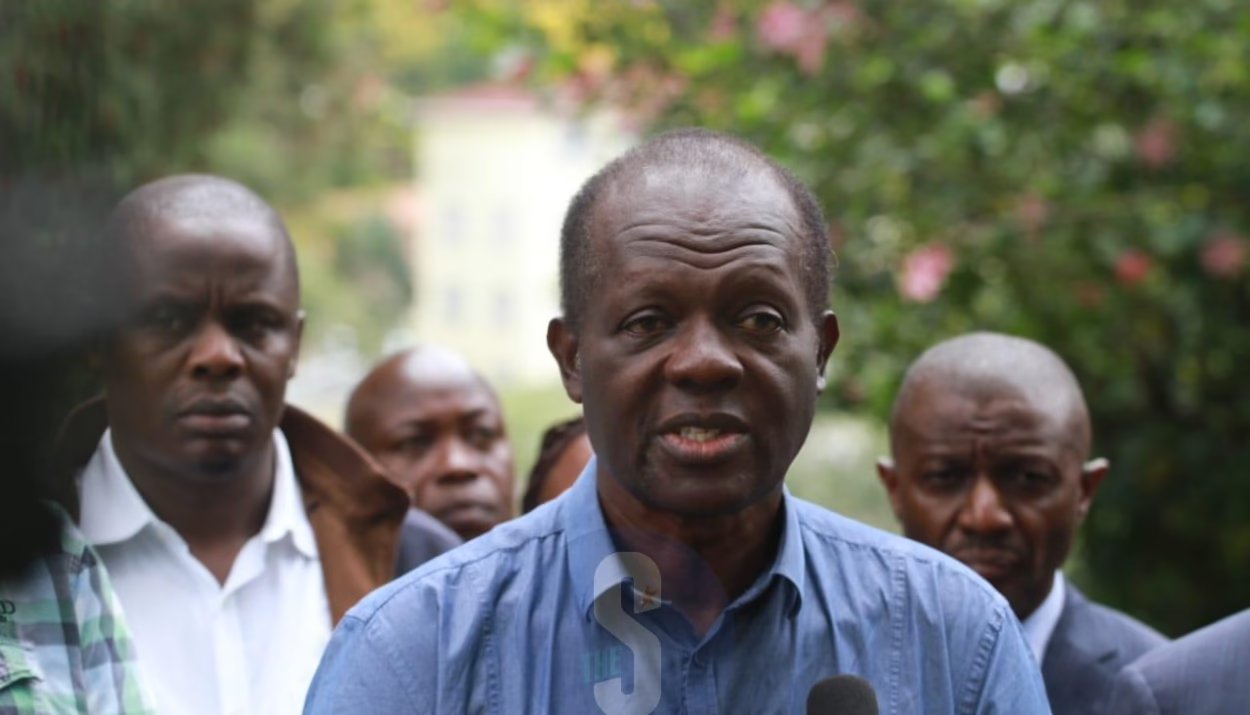

On March 21 evening, former Kenyan Foreign Minister Raphael Tuju was scheduled to appear for a radio interview. He never made it. His vehicle was later found abandoned on a quiet road in Karen, Nairobi, with its hazard lights flashing, his phone switched off. For nearly 48 hours, Kenya held its breath, fearing the worst .
When Tuju finally resurfaced, he claimed he had been forced into hiding after being trailed by an unmarked vehicle. But police quickly turned the tables—accusing the former cabinet secretary of staging his own disappearance . The incident marked a dramatic new chapter in the story of a man who built one of Kenya’s most impressive business empires, served in the highest levels of government, and now finds himself locked in a desperate battle to keep it all from crumbling.
Humble beginnings
Raphael Tuju’s story does not read like that of a man who would gamble away his wealth. Born in 1959, he started his career as a journalist at a time when media salaries in Kenya were modest at best . But while his colleagues unwound after work, Tuju stayed behind, chasing stories and editing scripts long after the newsroom had emptied, he said in the past.
When party-going colleagues asked the teetotaler Tuju to take on extra assignments for small fees, he gladly accepted. The extra income and relentless hours began to accumulate. Piece by piece, he started acquiring prime properties in the leafy suburbs of Karen and Upper Hill—a feat few journalists of his generation could claim .
What began as the hustle of a hardworking broadcaster gradually blossomed into a formidable business empire. Tuju founded Ace Communications, a successful public relations and communications firm, and began accumulating real estate assets that would eventually make him one of the wealthiest figures to emerge from Kenya’s media fraternity .
The Empire: Dari, Entim Sidai, and prime real estate
At the heart of Tuju’s business empire lies the Karen neighborhood of Nairobi, an upscale suburb favored by diplomats, wealthy families, and expatriates. Here, Tuju assembled a portfolio of properties that became the foundation of his wealth.
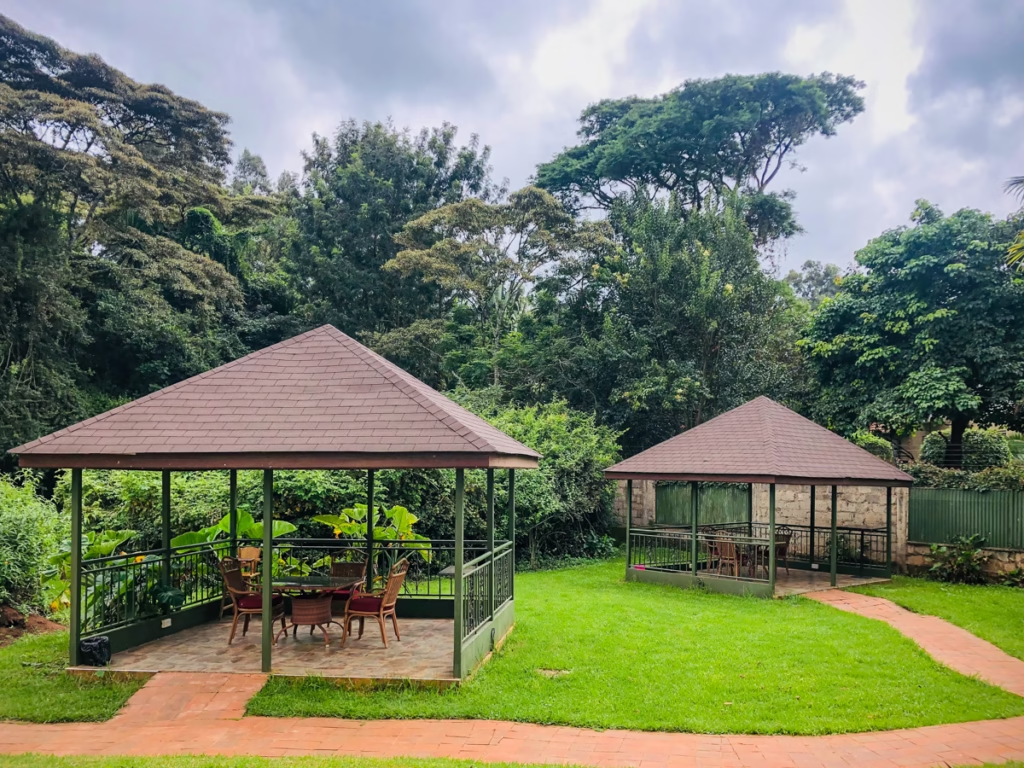
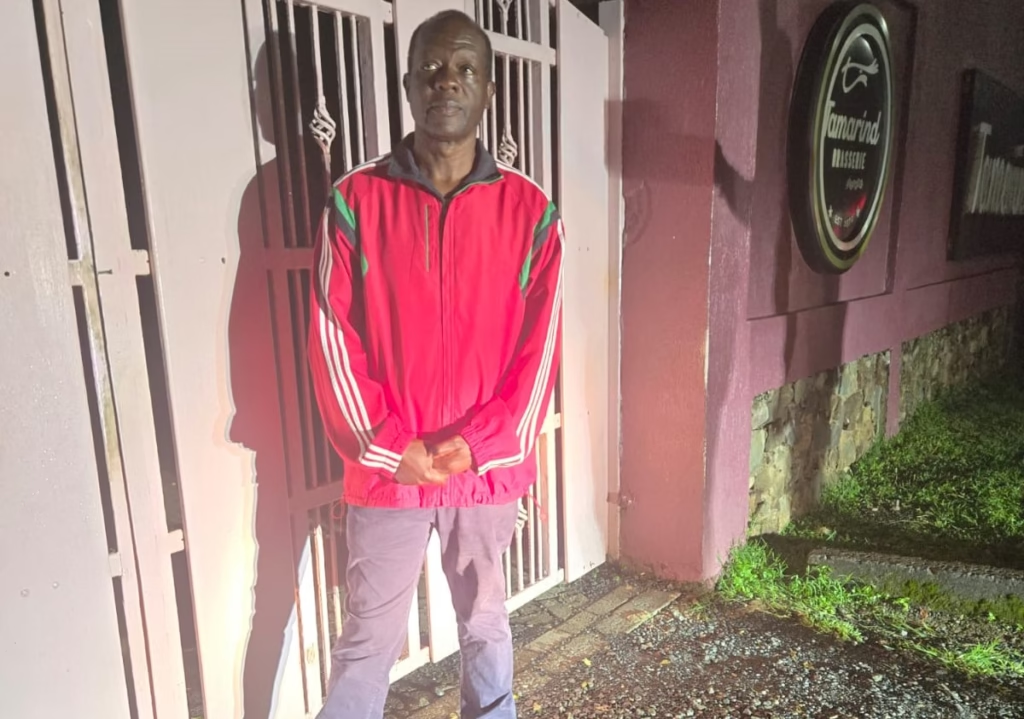
Dari Business Park and Restaurant sits on approximately 2.787 hectares (6.887 acres) off Ngong Road, about 1.2 kilometers from Karen Roundabout. The property includes a restaurant trading as Tamarind Brasserie Karen, complete with a main building, conference hall, gazebos, pavilions, manicured lawns, and commercial buildings let to individual tenants. The property is held on a 99-year leasehold from September 2010, with about 85 years remaining .
The restaurant itself was a hidden gem—an eco-park themed establishment set in an indigenous forest with beautiful plants and flowers. The grounds hosted wildlife including Thomson’s gazelles, impalas, bush babies, tree squirrels, peacocks, cranes, hornbills, and sunbirds .
Entim Sidai Wellness Sanctuary, Tuju’s crown jewel, spans approximately 8.164 hectares (20.2 acres) off Tree Lane in Karen. The property features a mix of older colonial-style structures and newer developments, including a nine-bedroom house, a two-bedroom bungalow, staff quarters, a swimming pool, and a lawn tennis court. At the time of a 2024 inspection, a residential section was under construction featuring 12 villas with five- and seven-bedroom standalone houses, each occupying plots of 0.25 to 0.5 acres .
Tuju’s personal residence in Karen has been described as a castle, with its massive size accentuated by twin stairways coiling at the front entrance. The mansion sits on well-manicured lawns with a mock waterfall, a swimming pool, and long glass doors that add to its grandeur. Tuju personally supervised the construction, forgoing a contractor to ensure every detail met his standards .
An independent valuation conducted by Knight Frank Valuers Limited on July 15, 2024, put the market value of the Entim Sidai and Dari properties at Ksh 1.395 billion and Ksh 590 million respectively, bringing the combined value to Ksh 1.985 billion (approximately $15.3 million) .
Political life
Tuju’s entry into politics in 2002 elevated his public profile and expanded his network of influence. He was elected Member of Parliament for Rarieda Constituency in Siaya County, a position that served as a springboard to higher office .
Under President Mwai Kibaki’s administration, Tuju rose through the ranks to become one of the most influential ministers in government, eventually serving as Minister for Foreign Affairs . He later became Secretary-General of the Jubilee Party during Uhuru Kenyatta’s presidency, cementing his status as a key figure in Kenya’s political establishment .
His political career was marked by remarkable survival. In 2003, while serving as a minister in Kibaki’s government, he survived a plane crash in Busia that killed a fellow minister and the two pilots. Years earlier, he had survived a near-fatal accident in the UK that left him with 18 fractures, including three broken vertebrae .
He would later reflect on these close calls with a mixture of fatalism and defiance: “Guys, I survived a plane crash. So what is this?”—a question he would come to ask repeatedly as his financial empire began to unravel .
The loan that changed everything
The seeds of Tuju’s current troubles were planted in 2015, when his company, Dari Limited, secured a loan facility from the East African Development Bank (EADB), a regional lender. The facility was structured in two tranches: $9.3 million (approximately Sh1.2 billion) for the acquisition of a 94-year-old Victorian bungalow in Karen for a project dubbed the Karen Retirement Home, and a second tranche of Sh294 million to commence construction work .
The plan was ambitious: transform Dari Restaurant into a high-end hospitality and residential complex comparable to the Windsor Golf Resort, owned by the family of former Cabinet minister John Michuki. The project envisioned 30 three-bedroom retirement homes, 36 cottages, a destination spa, and expanded accommodation facilities. Projections by audit firm KPMG forecast revenues from property sales at around Sh2.28 billion against the Sh1.19 billion loan, representing an internal rate of return of 11 percent over 10 years—slightly above the 10 percent cost of loan funds .
But the deal went south. According to Tuju, the EADB breached the contract by failing to advance the second tranche of Sh294 million, disrupting the project’s cash flow and making it difficult to proceed with development as planned . The lender countered that the funds were not disbursed because the borrower had already breached key terms of the loan agreement—specifically, failing to present architects’ certificates of works completed within the agreed drawdown period and failing to provide additional security in the form of Tuju’s Upper Hill property .
By 2017, the facility had fallen into default .
Legal battles across two continents
What followed was a vicious legal dispute that has played out across multiple jurisdictions and courtrooms for nearly a decade.
The loan agreement contained a clause stipulating that any dispute would be arbitrated in a foreign jurisdiction, with rulings binding in Kenya. In December 2018, EADB invoked this clause and moved to a London court to compel Dari Ltd and the loan guarantors—Tuju, his three children, and their S.A.M Company—to repay the money .
In 2019, the High Court of Justice in England and Wales issued a summary judgment ordering repayment of more than $15 million (approximately Sh1.9 billion) under the facility agreement . The following year, the ruling was recognized and registered by the Kenyan High Court under the Foreign Judgments Reciprocal Enforcement Act, allowing the lender to pursue recovery using Tuju’s assets within Kenya .
From that point forward, the matter moved through various levels of the Kenyan judicial system. Tuju’s legal team filed multiple challenges, including petitions to the Judicial Service Commission seeking to have some judges recuse themselves from the matter on allegations of bias. The dispute eventually climbed all the way to the Supreme Court of Kenya, with Tuju suffering setbacks at virtually every stage .
Tuju has consistently maintained that he was wronged by the bank’s failure to disburse the second tranche of funds. But the courts have repeatedly sided with the lender’s right to enforce the security attached to the loan .
The empire crumbles
By 2024, the pressure had become overwhelming. Interest had accumulated, legal costs had mounted, and the outstanding debt had expanded significantly—with the bank seeking to recover more than Sh4.5 billion through the sale of collateral properties .
In October 2024, the Dari Coffee and Garden restaurant was auctioned to a buyer for approximately Sh450 million after a court allowed the lender to proceed with recovery efforts .
In March 2026, the High Court cleared the way for EADB to auction three properties in Karen linked to Tuju, including the Entim Sidai Wellness Sanctuary, in a bid to recover the outstanding debt . An auction notice was issued, and on March 14, enforcement officers executed court orders in the early hours of the morning, with armed officers entering his Karen property at approximately 2:00 a.m. .
Tuju claimed that the officers did not present a court order at the time of the operation, describing it as an unlawful eviction. “If it is law, then it is the law of the jungle,” he said in a late-night video address to Kenyans . He alleged that dozens of police officers had raided his property, ejected his staff and security guards, and taken control of the business premises .
His legal team managed to obtain a temporary reprieve on March 18, when the High Court blocked any transfer or assignment of the disputed property until his latest application could be heard . But the reprieve appeared temporary at best.
March 2026
On the evening of March 21, 2026, Tuju and his driver left for a radio interview. They never arrived. His vehicle was found abandoned on Miotoni Lane in Karen, hazard lights on, phone switched off .
The family immediately raised alarm. Tuju’s son, Mano, reported that attempts to reach his father had failed. The family’s lawyer, Paul Nyamodi, revealed that Tuju had, prior to his disappearance, filed a police report about being trailed by an unmarked vehicle . Just three days earlier, Tuju had written an open letter to Inspector General of Police Douglas Kanja, seeking intervention over concerns tied to his property and security .
News of the disappearance spread rapidly, with prominent opposition figures alleging abduction. Governor James Orengo claimed Tuju had been “kidnapped,” while lawmaker Otiende Amollo pressed authorities for answers, saying, “We abhor the possibility that there are people who can abduct someone of [his] stature” .
For nearly 48 hours, Kenya watched and waited.
Then, on March 23, Tuju resurfaced. Speaking to Citizen TV, he explained that he had gone into hiding after realizing he was being followed. He claimed he had turned onto a side road to lose the pursuers, abandoned his vehicle, and found shelter with a family in Kiambu County until past midnight, after which he returned home .
“My family is very traumatised,” he said, “and I consider myself blessed because there are many Kenyans in unmarked graves”—a reference to other Kenyans who had been abducted or killed in recent years .
But the response from law enforcement was swift and unexpected.
The police counter-narrative
Director of Criminal Investigations (DCI) Mohammed Amin held a press conference on March 23, accusing Tuju of deception. Based on “solid intelligence and meticulous forensic analysis,” Amin stated that Tuju had been physically present at his Karen residence throughout the period in question—including at the precise time his phone was switched off at 6:18 p.m. on March 21 .
“Following the denial of access, we deployed a multi-agency team to secure the residence and preserve the integrity of the investigation,” Amin said, referring to the family’s refusal to allow investigators into the home. He stressed that the alleged disappearance was not genuine and that Tuju had “stage-managed” the incident .
“When confronted with the reality that police were closing in on the truth and that his deception could no longer be sustained, Mr. Tuju chose to resurface, thereby confirming the investigators’ earlier well-founded suspicion that this was a carefully staged disappearance rather than a genuine case of abduction,” Amin said .
Tuju was arrested shortly after speaking to the press and taken to Karen Police Station to record a statement. His lawyers alleged that he was manhandled and sustained injuries during the process, demanding that he be taken to Karen Hospital for medical attention .
The man behind the headlines
For those who know Tuju’s story, his current predicament is a stark departure from the narrative of resilience that has defined his life.
He has often spoken of his strength coming from his mother, Mary, a woman who refused to give up hope despite extraordinary adversity. Mary’s own mother died while giving birth when she was just three years old; three years later, her father also died, leaving her an orphan. Yet Mary never gave up .
The young Tuju was sickly while growing up, and his mother—who had already lost two other children—brought in priests to pray for him in case he died. He did not die .
That same resilience carried him through the plane crash that killed his colleagues, through the near-fatal car accident that left him with 18 fractures, and through the brutal world of Kenyan politics. Today, he insists it will carry him through this storm as well.
“I encourage Kenyans who are going through this kind of thing to stay steadfast and fight for their rights,” he said in one of his late-night addresses .